Conducting
Conducting – A Beginner’s Guide
Aidan Fozard, Co-MD of East Anglian Regional Team
Ever wanted to step the other side of the tables and stands? My hope is to give you a better idea as to what the fool in front of you is attempting to do and maybe give enough information to allow you to give it a go yourself. As a small disclaimer to the more musically educated, I will simplify and generalise things at times for the benefit of the reader, and writer!
Let’s start with some basics.
The conductor may want to wave their hands or baton around but it is key to know where the intended beat is. This is best communicated through consistency. The ringer needs to know exactly where they are in the bar from a quick glance between notes. The general theory is therefore to have a bounce line. This is the same horizontal line in space that all your beats sit on. For me, this tends to be around mid-torso height. Whenever you pass this line, you are indicating the beat. You may bounce below it or come from high above, but the line is the key.
When moving, you need to have a high level of consistency, at least for the feeling of that section. The ringers need to be able to anticipate where the beat will come, rather than having to guess and/or stab the bell at it. The beat itself can come with a flick to aid clarity as to where the beat line is, but your other movements between beats should be consistent in speed/acceleration. No pausing and sharp movements (unless that is what you are musically going for of course).
Next, where should your beats be? There are 3 general rules to follow.
- Number one, the first beat is always straight down.
- Secondly, the final beat is always a return to a high start position.
- The third rule is that the penultimate beat shall always be sideways and away from your body.
Let’s put some of these to practice. If you are beating in 2 (2/4 or 6/8 time signatures for example), you start high and move your hand down with a flick and slight outward motion. The second beat will move inwards again and up. If you are right handed, this will look like a mirrored letter J to you, and a correct J to the ringers.
Beating in 3 (3/4, 7/8, 9/8 and some others) is therefore a simple extension of this. The first beat is straight downwards. This time, I tend to bounce straight up rather than out, but either is fine. Beat 2 will cross the beat line from above and move out, away from your body. The final beat will cross the line before moving diagonally back to the starting position. It is worth noting that, given this is effectively a triangle, the final movement along the hypotenuse will need to be at a slightly greater pace, although this will be natural and does not need overthinking.
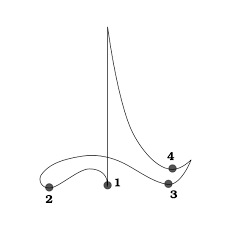
Beating in 4 (4/4, 12/8 and common time) is similar to 3. Your first beat is straight down, but the second this time goes inwards or across your body. The third is out and away, as per rule three. Finally, the forth is diagonally up to our starting position, as per beats 2 and 3 above.
The best way to practice is in front of a mirror. You may feel self-conscious doing so, but it will help fine tune your clarity.
HRGB run occasional weekend sessions for team leaders, potential team leaders and existing conductors who would like to develop their conducting and musical directing (MD) skills. Contact the National Secretary for details