More conducting
More About Conducting
Aidan Fozard, Co-MD of East Anglian Regional Team
We've looked at the basic beat patterns and shapes; now we will look at how we can nuance these movements to influence the ringers and the feeling the audience perceives of your music.
Your movements should match the feel of the music at that time. This may vary during the piece as you wish to emphasise different moods, dynamics or rhythms. Handbell ringing is a visual art as much as it is an oral one. We see the music as well as hearing it. We therefore need to be aware of all the messages being given the audience.
When studying the score prior to conducting it, think through how you would like the piece to both sound and be perceived as sounding, making notes on the music as required. If you can get the two combined, the audience will enjoy the show much more.
First consideration for me is the mood of the section. Is this a flowing, heart-strings-pulling legato section or a choppy exciting staccato? Do I want the ringers to move smoothly and flow with the piece or sharply and exact with short notes, either due to techniques or speed?
With a legato, I need to make my movements as smooth and flowing as possible, while ensuring I am still clear as to the position of my beat. My hands or baton should float gently over the beat. I will also consider my body position; probably relaxed shoulders, perhaps a gentle sway, a calm look on my face and, hopefully, a smile as I make eye contact with the ringers. The audience will see my calm and relaxed stance reflected on the ringers and this will emphasise the mood of the music they are hearing. This is not a time to be stabbing at notes in a panic but to be ringing with smooth movements and an air of “I’ve got this all in hand”. If you are a team that uses circular ringing motions, I would be looking for those arm movements to be large and smooth.
Now let’s consider the opposite. For a staccato section I will conduct with a more jagged and pointed motion. I want to push the beats with harsh exact movements that are regular and predictable. Depending on the dynamics, my shoulders may be a little more tense, my stance more upright and movements more contained. I may dart my gaze around the ringers a little more (rather than scanning slowly from left to right). My face may be harsher and more intense or with a look of energy. I would hope the ringers would match, with smaller movements that are more direct and pointed. Their look should also be more intense, if still exuding their inner confidence.
My next consideration would be dynamics. You could have a loud flowing section or a quiet and intense staccato, so we need to indicate which mood we want the ringers to be performing in.
The simplest method to alter dynamics is by adjusting the size of your conducting. Make your movements smaller for quiet phrases and a little larger for louder – but don't overdo it and become distracting.
I will often use an upwards palm – either my baton hand and/or my left – for louder and downwards for quieter. If I need a really big increase or the ringers are ignoring me, I may add some finger movement to this; I try to not resort to mouthing “MORE!” or “SHHH!” if I can help it. A palm facing the ringers will generally indicate slowing while quietening. If I want a really big volume, I will stand very upright and puff out the chest a bit. I might contract a little for those quieter, meeker sounding sections.
My final consideration is the overall feeling of the piece. Is it a serious work, a swaying song or a fun bouncing showpiece? Take Offenbach’s Can-Can setting as an example. It is a loud and fast paced piece with many short notes. That would imply, based, on the article so far, larger and sharper movements with a relatively serious and still air. But the piece is meant to feel fun and free. If one were to conduct it in a very angular way it will be at odds with the feeling we are trying to portray to the audience. I may therefore conduct it with a bounce in my movements. Perhaps with my feet more in front and behind me so I can rock a little back and forth. I would want the ringers to be smiling and moving – looking like they are enjoying it as much as the audience should be.
Of course, if it were a more serious or sombre piece, we may be more statuesque. My feet will be aligned and I would try to keep my body and shoulder movements to a minimum.
A song, particularly gospel or from the shows, may require a bounce in the beat, a gentle sway from side to side, or even a full-on step. Your head should also be held higher and maybe itself sway in time with the music.
Think of these as 'modifiers' of the above. You may go through several moods in a piece, but which need to each be conveyed, but the overall feeling of the piece will determine how you show those moods.
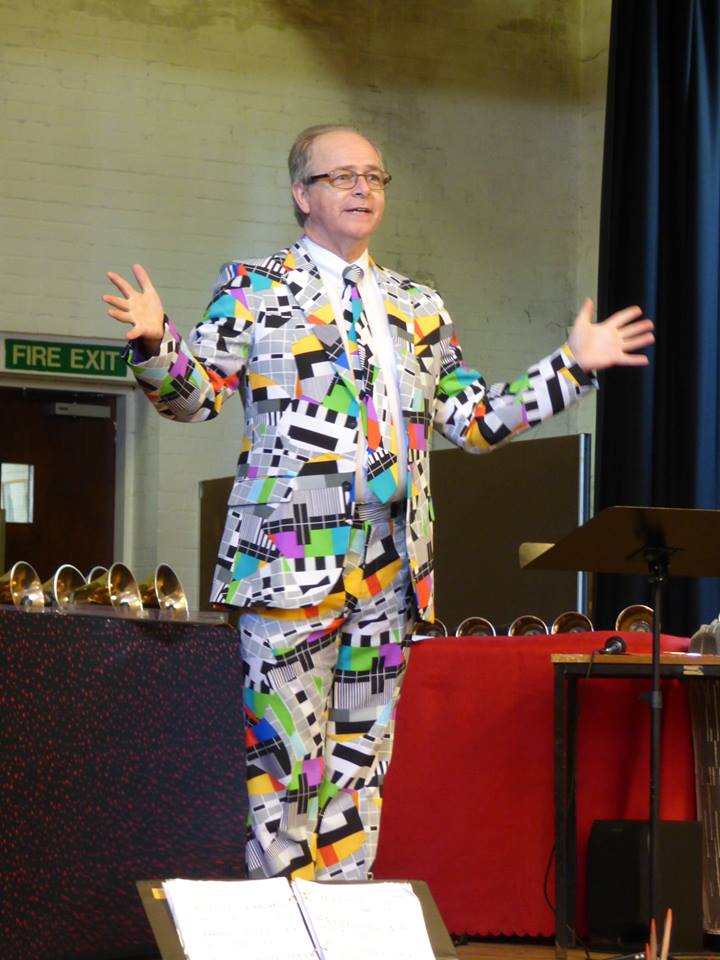
Get the ringers to LOOK at the conductor - below, Martin Winter gaining their attention