Four in Hand Ringing
Four in Hand Ringing
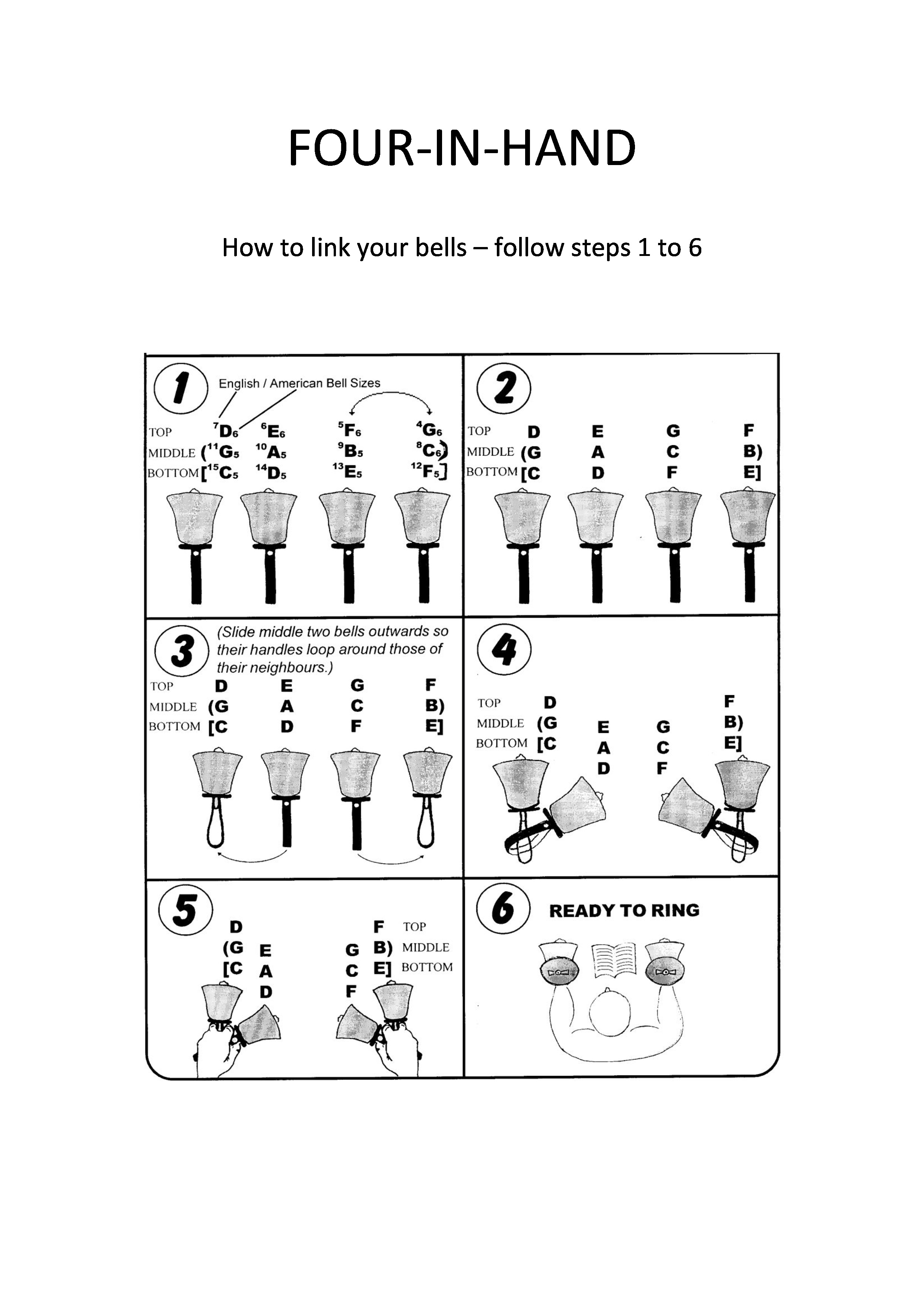
Four in hand (indeed in some cases six in hand!) is a useful technique for a whole team to try, or just to cover more bells when ringers are missing for rehearsal.
Holding the bells:
- Don’t try to ring bells that are too heavy for you
- Grip firmly but not tightly
- Make sure your hands are hard up against both caps
- Don’t let the bells flop about - a sure way of turning leather handles into ‘tulip stems’
- When not ringing, relax by hold the bells flat against the body or, better still, rest them on the table
Ringing:
- You can ring in or out, up or down (more of a forwards direction really) – decide which is most comfortable for you
- Cultivate a smooth and graceful movement
- Get moving well before the note is required
- At the moment the note is required, reverse the direction the bell is moving
- Come to rest slowly (to avoid ‘double clappering’)
- Don’t snatch at the bells
Movement:
- ‘Feel’ the music and try and move with it.
- Keep your hands relaxed and wrists loose
- Try not to be stiff or wooden
- Hold the bells well up so that the sound will project to the audience
- Practice ringing more than one bell at a time – both bells in one hand can be rung by using a diagonal motion – rather like a tick ( ) To ring an across bell in one hand and a down or forward bell in the other, turn the hand with the across bell in front of the body and ring both bells forwards.
Damping, the big argument:
- Some say that bells should not be damped; (“Bells were never made to be damped – you can’t damp a church bell!”) Others say we are not just bell ringers but musicians (“Church bells tend not to use sharps and flats!”), therefore we should be musically correct and observe note lengths
- It’s your choice - but we prefer to damp when appropriate - and when possible because It gives more expression It avoids ‘build up’ of sound - especially on bass bells But don’t damp too early or you will leave gaps in the music
- Experiment with brush damping (gently touching to the body – will produce different effects depending on the cloth)
- Hard or sudden damping is useful for effect – but can be disconcerting in the wrong place
Ringing from music:
- Not as hard as it looks, especially if you mark the music in advance.
- Try marking the music with vertical lines for the lower bells in your hands, horizontal lines for the upper bells – we use red for the right hand, green for the left.
- So, for a hand comprising D and E in the left hand the music would be marked in GREEN: and for F and G in the right hand in RED:
- Some people prefer to adopt the nautical option and reverse the colours
- Accidentals (shap or flats) can be marked with a dsitinctive colour (blue or purple say)
Other tips:
- Don’t give up if the music calls for more bells than you have ringers multiplied by 4!
- You could try 6 in hand for the higher bells or cope with extra bells by picking another set up off the table when required.
- As an alternative, you may find it easier to link the bells with the heaviest on top (ringing across) and the lighter ones underneath (ringing forwards – or upwards if you prefer). If you mark the music, make sure you mark it accordingly!!
For more information see here