Care and Maintenance
|
Handbells in need of restoration work? Work undertaken includes: New Handles, New Caps, Tuning and polishing, Clappers polished with new pegs, New Staples, Springs and felts. Lewis Benfield. My telephone number is 07427202060 or see my Facebook page. |
Care of English Handbells
- Do handle the bells with care - The metal is necessarily brittle and will not stand rough handling or dropping on the floor.
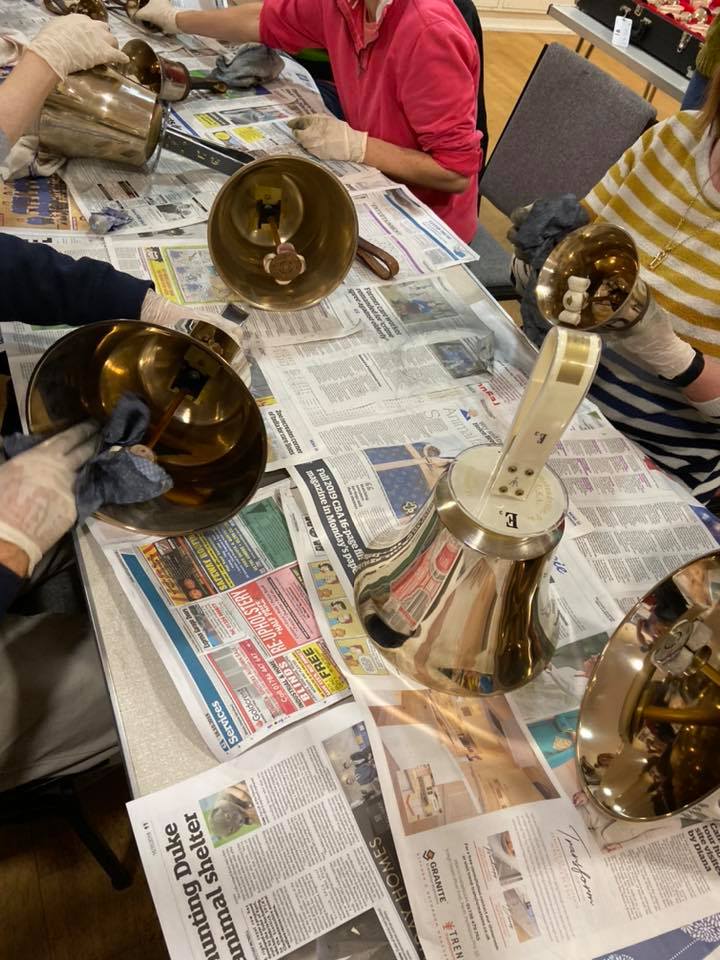
- Don't touch the metal surface unnecessarily - The Foundry send out the bells with a very high polish, and this can only be maintained by an occasional rub with a clean dry and soft chamois leather. Moisture from fingers causes local tarnishing.
- Do use metal polish or impregnated cloths - to remove any tarnish that the chamois will not. Metal polish two or three times a year will do no harm; HRGB sell a specially formulated polish for musical instruments - Peek Polish which shines to a mirror finish. For heavily stained or tarnished bells try Autosol - available from motor accessory stores such as Halfords.
- Don't clean the bells with abrasives - If you must use a buffing machine, use a soft mop or jewellers' rouge. Nothing coarser.
- Do store your bells in a clean, dry place - Moisture and light will tarnish them. If you are lucky enough to have a room where your bells are left out between practises, cover them with a sheet to avoid sunlight.
- Don't remove felt buffers from clappers - They are fitted to the larger bells (usually 18G and down), and are graded to give the finest tonal response.
- Do apply a spot of a light oil lubricant - either side of the clapper where it swings on the nylon staple pin. Only very occasionally, if they dry and rattle slightly, and only a tiny drop.
- Don't stand large bells mouth downwards - 22C and larger are heavy bells and you may set the springs out of adjustment, or damage the clapper pegs and felts.
- Do grip the handles close up to the leather caps - when playing. The Foundry take special care to make a smooth finish flush to the rivets for this purpose, and proper handling will lengthen the life of the handles indefinitely.
- Don't pack the bells jumbled in a box - where they will get scratched and the handles and clappers damaged. The Foundry can supply fitted cases tailored to any range of bells up to the full five octaves. Alternatively make a separate bag for each bell and store them snuggly in a wheeled suitcase.
If a bell does not ring very easily, check the action of the clapper and, if necessary, lubricate with just a drop or two of thin oil (eg sewing machine oil).
A bell that consistently double clappers (i.e.. rings at an unwanted time, usually on the back stroke), may need a slight adjustment to the springs. These are thin sheets of metal (usually brass or copper) with felts affixed to the end. These can be carefully bent to the correct point - hold the bell horizontally, the clapper should be just clear of the surface of the bell. Slowly rotate and the clapper should, again rest just clear of the metal. Be careful not to bend the springs too often as this will weaken them and they will snap or become too weak.
One of the charms of English handbells is the 'rattle' that develops as the bells age and the staple pin wears. It is possible to correct this yourself (see Richard Page's record of how he did this) DIY English bells.pdf. In 1996 Whitechapel Bell Foundry published a guide to handbell maintenance; this can be downloaded from the link below (please ignore all references to their address/email/telephone number etc.)
Care of American Bells
- Keep your bells cleaned and polished
- Polish the outsides with Simichrome, Peek, Blue Magic or similar specialist nonabrasive polish.
- You are tripling your work and trouble if you polish the insides of your bells. Keep them clean, but don’t bother polishing them!
- To keep polish out of the insides, polish the bells face down (the bells, not you!) on a towel on a table top.
- Wipe your bells down with a polishing cloth each rehearsal before you put them away.
- Wipe off the residue from the polishing cloth with a duster, not the outside of the polishing cloth. (You can wash the duster. You can’t wash a polishing cloth without ruining it.)
- The insides can be wiped with a slightly damp (NOT wet, just damp) cloth.
- Dust can be blown off the springs with “dust off” or similar compressed gas in a can.
- Finger prints inside can probably be rubbed off with a polishing cloth.
- Store your bells properly
- Keep them in an environment that isn’t hot or humid.
- Heat and humidity promote tarnishing.
- If your cases get damp, open them up and dry them out in a heated or air conditioned environment.
- Do not let the cases sit where the sun can shine through a window on them.
- Polish your bells thoroughly before you put them away for the summer.
- Vacuum out the cases once in awhile.
- Keep the handles tight
- If you notice a handle is starting to wiggle when you polish the bell, tighten it.
- Line up the clapper, handguard and handle so they are properly oriented with the strike point in the casting. Then tighten the cap screw in the handle. When you tighten, pinch the clapper against the casting so the inside is immobilized and does not want to turn with the cap screw when you tighten it. Then crank it down good and tight - not with all your strength, but tight, so it won’t wiggle when you polish the bell.
- Keep the springs adjusted
- A properly adjusted bell is easy to ring forward, but not so easy that it rings itself when you go to lay it down. It should be difficult to ring backward, so you do not get a back ring when you pick it up quickly, but not impossible to back ring, so when you shake it, the clapper will still strike on both sides of the casting. That’s called “uneven tension” - easy forward, difficult backward.
- Adjust the clappers for proper voicing
- Don’t fall victim to the trap of “Oh, we’re going to ring loud, let’s set ‘em on Hard. Now, we’re going to ring softly, lets set ‘em on Soft.”
- Set the clappers on your bells (Soft, Medium, or Hard) so that each bell’s timbre blends best with the rest of the set. A good place to start is to set all your clappers on M (medium) and then ring up and down the scale, listening and comparing. Tone down or bring out bells that are relatively too strong or too weak compared to the rest of the set by moving their clappers to a softer (S) or harder (H) setting.
- Achieve dynamics with ringing technique, not by fooling with the clapper settings. Yes, clapper settings will affect dynamics, but that also affects the timbre or 'colour' of a bell’s sound. Think of your set of bells not as a collection of instruments, but one instrument that is a collection of bells. A piano is one instrument with 88 keys, not a box with 88 instruments in it. The piano technician “regulates” a piano with that 'one instrument' approach. You can voice your set of handbells the same way.